VANCOUVER, British Columbia, Feb. 23, 2026 (GLOBE NEWSWIRE) -- Ero Copper Corp. (TSX: ERO, NYSE: ERO) ("Ero" or the “Company”) is pleased to announce results of the Preliminary Economic Assessment ("PEA") on the Furnas Copper-Gold Project ("Furnas" or the "Project"), located in the Carajás Mineral Province in Pará State, Brazil.
The PEA outlines the potential for a large-scale, long-life copper-gold operation with a robust production profile and exceptional economics, reinforcing Furnas as a cornerstone asset within the Company's organic growth pipeline. Furnas is being advanced in partnership with Vale Base Metals ("VBM") pursuant to an earn-in agreement wherein the Company will earn a 60% interest upon completion of the prescribed work programs.(1)
HIGHLIGHTS
- 24-year initial mine life based on an updated mineral resource estimate that remains open to depth and laterally along strike.
- Average annual copper equivalent(2) production of approximately 108,000 tonnes over the first 15 years of operation, including approximately 70,000 tonnes of copper, 111,000 ounces of gold, and 532,000 ounces of silver per year.
- After-tax net present value ("NPV") (8%) of $2.0 billion and a 27.0% after-tax internal rate of return ("IRR") based on long-term copper, gold and silver prices of $4.60 per pound, $3,300 per ounce, and $40.00 per ounce, respectively.
- At $6.10 per pound copper and $5,550 per ounce gold, the Project's after-tax NPV (8%) more than doubles to $4.7 billion, with the after-tax IRR increasing to approximately 44.0%.
- Life-of-mine ("LOM") C1 cash costs(3) of approximately $0.30 per pound of copper produced, supported by significant gold and silver by-product credits.
- Initial capital expenditures of approximately $1.3 billion at low capital intensity of approximately $16,000 per copper equivalent(2) tonne.
- LOM production totaling over 1.2 million tonnes of copper and approximately 2.0 million and 9.0 million ounces of gold and silver, respectively.
- The Company is evaluating several opportunities with the potential to increase value, including ongoing exploration drilling, the addition of a magnetite recovery circuit to produce a high-grade magnetite concentrate as by-product, and a gravity pre-concentration stage to enhance gold recovery.
“The results of the PEA on Furnas, the first ever published on the Project, reinforce what an exceptional asset it is," said Makko DeFilippo, President & Chief Executive Officer. "The PEA outlines a large-scale, long-life copper-gold operation with strong underlying economics, supported by low capital intensity, first quartile operating costs and an attractive internal rate of return across a wide spectrum of commodity prices.
"The announcement today is the culmination of multiple exploration drilling campaigns and a strong foundation of engineering and technical studies that have been developed on Furnas over more than a decade. While already a unique asset in a class of its own, the deposit remains open, and we are excited by the potential we see to further increase the known extent of mineralization, adding incremental value and mine life. Ero's strategy has been centered upon responsible mine development, with a significant portion of the Furnas LOM production expected to be sourced from underground. This approach has resulted in a reduced footprint when compared to alternative, less-selective, scenarios and a design that aligns well with our operational strengths. We are thrilled to be working alongside such a strong partner in VBM to advance exploration, engineering and permitting workstreams to deliver value for all stakeholders of the Project."
The PEA is preliminary in nature and includes inferred mineral resources, which are considered too speculative geologically to have the economic considerations applied to them that would enable them to be categorized as mineral reserves, and there is no certainty that the PEA will be realized. Mineral resources that are not mineral reserves do not have demonstrated economic viability.
Sensitivity of Economic Results to Copper and Gold Prices

(1) For more information on the Company's plans to earn a 60% interest in the Furnas Copper-Gold Project, please see its press releases dated October 30, 2023 and July 22, 2024.
(2) Copper equivalent based on long-term metal prices of $4.60/lb Cu, $3,300/oz Au, and $40.00/oz Ag.
(3) C1 Cash Cost is a non-IFRS Measure. Please refer to the Notes section of this press release for a discussion of non-IFRS Measures.
Preliminary Economic Assessment Summary
| Unit | Long-Term Prices | ||||
| Financial Highlights | |||||
| Copper Price | $/lb | $4.60 | |||
| Gold Price | $/oz | $3,300 | |||
| Silver Price | $/oz | $40.00 | |||
| Foreign Exchange Rate | USD:BRL | 5.50 | |||
| Initial Capital | $M | $1,280 | |||
| Phased Expansion Capital(1) | $M | $287 | |||
| Sustaining Capital | $M | $1,230 | |||
| After-Tax NPV (8%) | $M | $2,040 | |||
| After-Tax IRR | % | 27.0% | |||
| After-Tax Payback Period | years | 3.1 | |||
| Unit | First 15 Years | Life of Mine | |||
| Processing Operations | |||||
| Mill Throughput Capacity | Mtpa | 13.5 | 13.5 | ||
| Total Tonnes Processed | Mt | 198 | 240 | ||
| Average Processed Grades | |||||
| Copper | % | 0.59% | 0.58% | ||
| Gold | g/t | 0.35 | 0.35 | ||
| Silver | g/t | 1.77 | 1.64 | ||
| Copper Equivalent(2) | % | 0.91% | 0.90% | ||
| Metallurgical Recoveries | |||||
| Copper | % | 90.3% | 90.3% | ||
| Gold | % | 74.6% | 74.6% | ||
| Silver | % | 71.0% | 71.0% | ||
| Average Annual Production | |||||
| Copper | kt | 70 | 52 | ||
| Gold | koz | 111 | 84 | ||
| Silver | koz | 532 | 374 | ||
| Copper Equivalent(2) | kt | 108 | 81 | ||
| Copper C1 Cash Cost(3) | $/lb produced | $0.24 | $0.30 | ||
(1) Expansion capital related to the Company's phased development strategy occurring after first production.
(2) Copper equivalent calculated using long-term metal prices of $4.60/lb Cu, $3,300/oz Au, and $40.00/oz Ag. Copper equivalent processed grade reflects relative recovery rate for each metal as outlined above.
(3) C1 Cash Cost is a non-IFRS Measure. Please refer to the Notes section of this press release for a discussion of non-IFRS Measures.
Recovered Copper Equivalent Production(1) (tonnes in thousands)
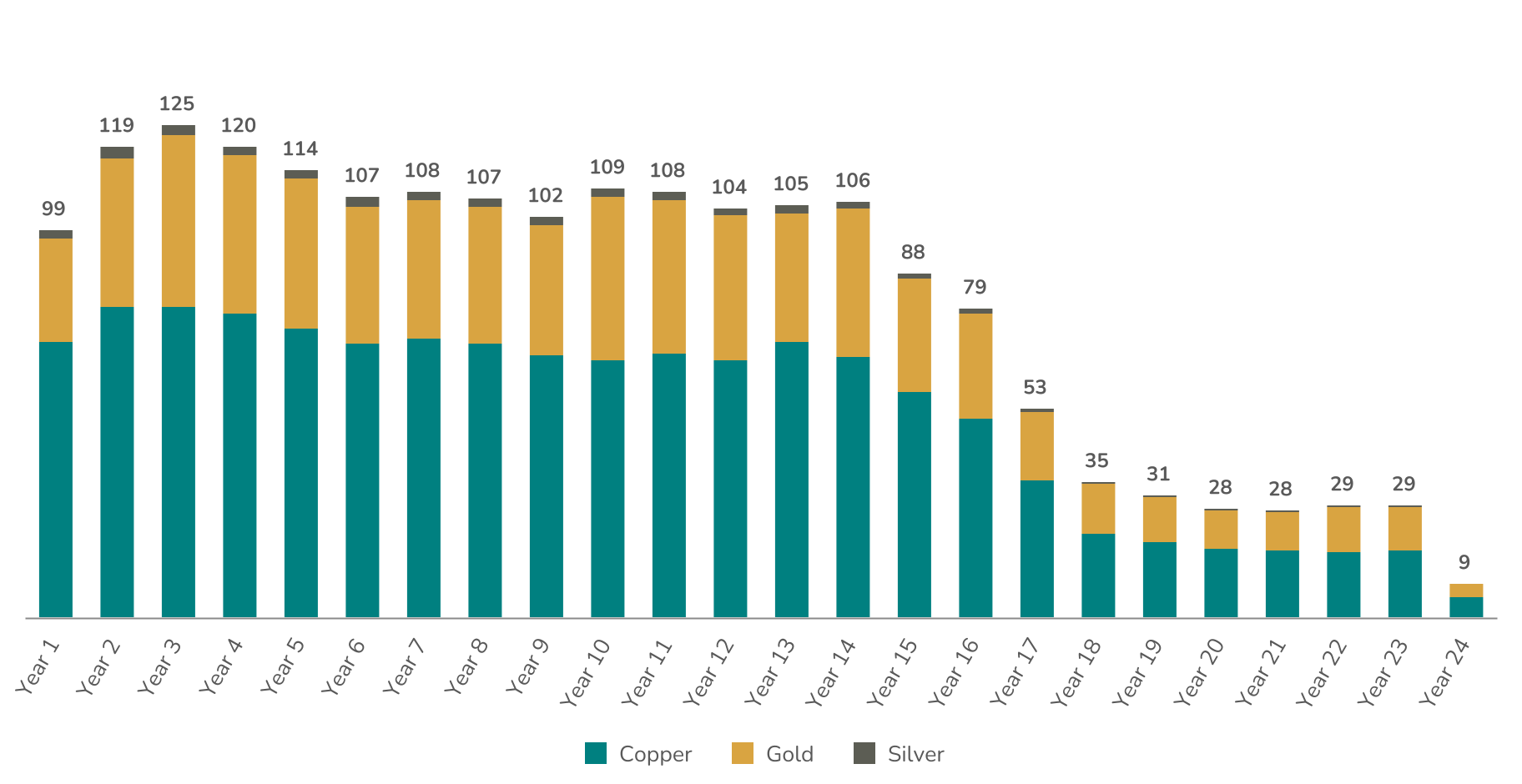
(1) Copper equivalent calculated using long-term metal prices of $4.60/lb Cu, $3,300/oz Au, and $40.00/oz Ag.
Exploration Strategy
The PEA and updated mineral resource estimate incorporate approximately 90,000 meters of historical drilling completed by Vale S.A. and Anglo American plc, together with 28,000 meters of Phase 1 drilling completed by the Company through July 2025. Subsequent drilling, including the 17,000-meter Phase 2 program, completed ahead of schedule in Q4 2025, and initial Phase 3 drilling, brings total drilling conducted by the Company to approximately 50,000 meters, with an additional 50,000 meters of drilling planned through the remainder of 2026. Results from the Phase 2 and Phase 3 programs are not included in the updated mineral resource estimate underpinning the PEA and will be reflected in subsequent resource updates and future engineering studies.
The Company's 2026 drilling strategy is focused on two primary objectives: (i) upgrading inferred mineral resources to higher confidence categories and (ii) extending mineralization along strike within the high-grade zones. The objective of targeted step-out drilling is to potentially expand the scale of the underground mining areas in both the Southeast and Northwest Zones adjacent to planned infrastructure to support higher sustained production volumes beyond year 16 of the current PEA mine plan.
Advancing Engineering, Permitting & Value-Enhancing Opportunities
With the completion of the Phase 2 drilling requirements in Q4 2025, the Company is advancing key workstreams to support future engineering studies in accordance with the Furnas earn-in agreement.
Over the next 12 to 24 months, activities on site will focus on continuing exploration drilling while advancing engineering, environmental and permitting work. Detailed geotechnical, hydrogeological and metallurgical studies are underway to optimize mine design, processing configuration and infrastructure layout. These studies are intended to further de-risk execution and refine capital and operating cost projections. Environmental Impact Assessment studies initiated in 2025 will continue through 2026, including baseline environmental work and engagement with regulatory authorities. Planning for public consultation and advancement of licensing processes at the local, state and federal levels are expected to progress during this period.
The Company is also evaluating several opportunities with the potential to enhance the value of the Project, including: (i) extending mineralization through ongoing exploration drilling, (ii) incorporating a magnetite recovery circuit to reduce tailings volumes and potentially generate additional by-product revenue through the production of a high-grade magnetite concentrate, and (iii) evaluating a gravity pre-concentration circuit to improve gold recoveries. These opportunities are in early stages of development and are not reflected in the economics presented in the PEA.
A Value-Driven Development and Operating Plan
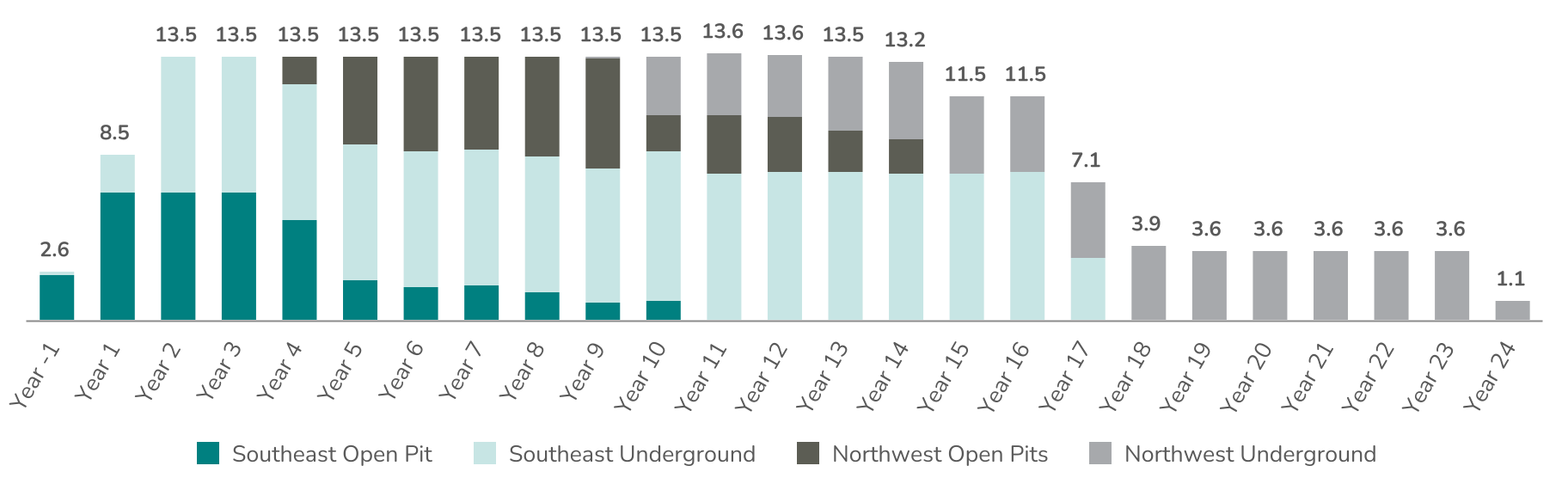
The PEA contemplates the development of Furnas as a large-scale, long-life mining operation comprising four distinct operating areas, incorporating a series of selective open pits and two underground mines within the two primary high-grade zones of the deposit - the Southeast and Northwest Zones. Mine production from open pit and underground mines will feed a centralized processing facility with a design capacity of 13.5 million tonnes per annum. Conventional flotation will produce a copper concentrate with significant gold and silver by-product credits over an initial 24-year mine life.
Development and pre-stripping activities during the initial three-year construction period are planned to focus on the Southeast Zone, with production commencing from the open pit, followed shortly thereafter by the underground mine. Once steady-state production has been achieved in the Southeast Zone, development of the Northwest open pit is expected to begin, with first production from this area anticipated late in year four of operations. Underground mining in the Northwest Zone is planned to commence towards the middle of the 24-year mine life, supporting production levels in the later years of the mine life.
This phased development approach and design criteria is centered upon a responsible mine development framework to minimize surface footprint, de-risk the Project's development plan, and enable an efficient capital expenditure profile. The strategy will allow for capital deployment to align with the progression of mining activities and projected cash flow generation.
Integrated Mine Design with a Conventional Processing Flowsheet
Mining from the open pits will be conducted using conventional truck-and-shovel operations, with the Southeast and Northwest open pits projected to produce 36.6 million tonnes and 37.5 million tonnes of mill feed, respectively, over the life of mine. Development is planned to commence in the Southeast Zone open pit, supporting the early years of production, with a projected life-of-mine strip ratio of approximately 2.8. Open pit mining in the Northwest Zone will comprise two adjacent pits with a blended life-of-mine strip ratio of approximately 3.6.
Trade-off studies were performed for the PEA to optimize design criteria including desired selectivity within high-grade zones, total production volumes, vertical development requirements, operability and economic outcomes. The unique geometry and continuity of mineralized zones over considerable strike lengths and favorable thickness, paired with rock mass quality enable underground mining rates of approximately 20,000 tonnes per day ("tpd") in the Southeast Zone and 10,000 tpd in the Northwest Zone. Underground mining in both the Southeast and Northwest Zones will use sublevel stoping mining methods incorporating both waste rock and cemented paste backfill. Over the proposed life of mine, the Southeast and Northwest underground operations are projected to produce 114.0 million tonnes and 51.6 million tonnes of mill feed, respectively.
Mined tonnage will be processed through a centralized sulphide flotation plant with a design capacity of approximately 13.5 million tonnes per annum, or approximately 37,000 tpd. The processing plant is based on a conventional crushing, grinding and flotation flowsheet using proven technologies currently in place across the Company's operations, minimizing operational risk at the contemplated production scale. Approximately 30% of tailings generated over the mine life is expected to be used for underground backfill requirements. Thickened tailings not used for backfill requirements will be deposited in a surface tailings storage facility.
The proposed flowsheet incorporates conventional three-stage crushing and milling paired with a multi-stage copper flotation and re-grind circuit designed to maximize copper recovery while maintaining concentrate quality. Metallurgical testwork demonstrates strong and consistent performance across a large variability dataset, achieving average copper recoveries of approximately 90%, producing a copper concentrate grading over 30% copper. Gold and silver are expected to be recovered as payable by-products within the copper concentrate, with average recoveries of approximately 75% for gold and 71% for silver.
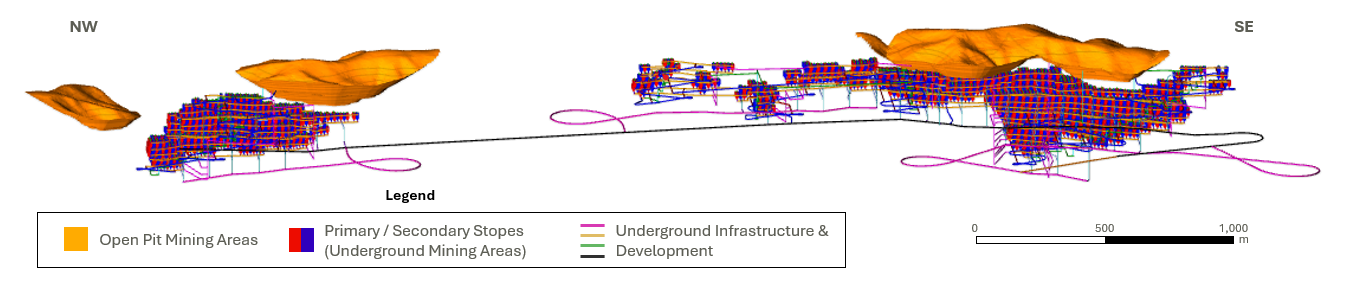
Figure 1: Cross-section view of the PEA mine plan, including four distinct and integrated operating zones (view looking Northeast).
Mill Feed Contribution by Mining Area (tonnes in millions)
Updated Mineral Resource Estimate
| Grade | Contained Metal | |||||||||||||||||
| Tonnes | Cu | Au | Ag | CuEq(2) | Cu | Au | Ag | CuEq(2) | ||||||||||
| Category | (Mt) | (%) | (g/t) | (g/t) | (%) | (kt) | (koz) | (koz) | (kt) | |||||||||
| Open Pit | ||||||||||||||||||
| Indicated | 272.2 | 0.59 | 0.31 | 1.66 | 0.83 | 1,594 | 2,748 | 14,546 | 2,252 | |||||||||
| Inferred | 117.1 | 0.51 | 0.31 | 1.24 | 0.75 | 601 | 1,160 | 4,662 | 876 | |||||||||
| Underground | ||||||||||||||||||
| Indicated | 3.4 | 0.57 | 0.23 | 1.44 | 0.75 | 19 | 25 | 156 | 25 | |||||||||
| Inferred | 78.8 | 0.53 | 0.31 | 1.50 | 0.77 | 418 | 791 | 3,809 | 607 | |||||||||
| Total | ||||||||||||||||||
| Indicated | 275.6 | 0.59 | 0.31 | 1.66 | 0.83 | 1,613 | 2,773 | 14,702 | 2,277 | |||||||||
| Inferred | 195.9 | 0.52 | 0.31 | 1.34 | 0.76 | 1,020 | 1,952 | 8,470 | 1,483 | |||||||||
Note: The Canadian Institute of Mining, Metallurgy and Petroleum ("CIM") Definition Standards (2014) were used for reporting Mineral Resources, which are effective as at November 30, 2025 and presented on a 100% ownership basis. The Mineral Resource estimate is reported on an in situ basis, with no operational, planned, or internal mining dilution, and no mining recovery factors applied. Minimum mining widths and/or geological constraints incorporated in the estimation methodology were applied to reflect reasonable mining selectivity and geological continuity and do not represent the application of operational dilution.
(1) All figures have been rounded to reflect the relative accuracy of the estimates. Summed amounts may not add due to rounding. Mineral resources that are not mineral reserves do not have demonstrated economic viability. See "Notes on Mineral Resources" below for additional technical and scientific information.
(2) CuEq grade for the updated mineral resource estimate calculated as Cu grade + ((Au grade x 0.03215 x $2,500 gold price x 74.6% gold metallurgical recovery) + (Ag grade x 0.03215 x $24.00 silver price x 71.0% silver metallurgical recovery)) / (0.01 x $9,039/tonne copper price x 90.3% copper metallurgical recovery).
Furnas is classified as an iron oxide copper-gold ("IOCG") deposit, characterized by copper and gold mineralization associated with iron oxide alternation. IOCG systems can be large and laterally continuous and therefore amenable to bulk mining methods, attributes that are consistent with the scale and development scenario contemplated in the PEA.
The updated mineral resource estimate incorporates approximately 90,000 meters of historical drilling completed by Vale S.A. and Anglo American plc, together with 28,000 meters of Phase 1 drilling completed by the Company through July 2025. The updated mineral resource estimate is based on integrated open pit and underground mining methods.
Results from the Phase 2 program (approximately 17,000 meters completed ahead of schedule in Q4 2025) and the ongoing Phase 3 program (approximately 50,000 meters planned in 2026) are not included in the mineral resource estimate and will be reflected in subsequent resource updates and future engineering studies.
Infrastructure Advantage in a World-Class Mining District
Furnas is located within the Carajás Mineral Province, approximately 50 kilometers southeast of VBM’s Salobo operations and approximately 190 kilometers northeast of the Company's Tucumã Operation. The Project covers roughly 2,400 hectares and benefits from close proximity to extensive regional infrastructure, including paved roads, an industrial-scale cement plant, a power substation, and Vale S.A.’s railroad loadout facility.
The region is a well-established mining hub with a deep network of suppliers, contractors, and technical service providers supporting both operating mines and development projects. The Project is situated less than 50 kilometers from Parauapebas, a mid-sized city with a population exceeding 250,000. Access to infrastructure, an experienced labor pool, suppliers and contracts is expected to support project execution and reduce the need for significant greenfield infrastructure investments associated with remote development projects.
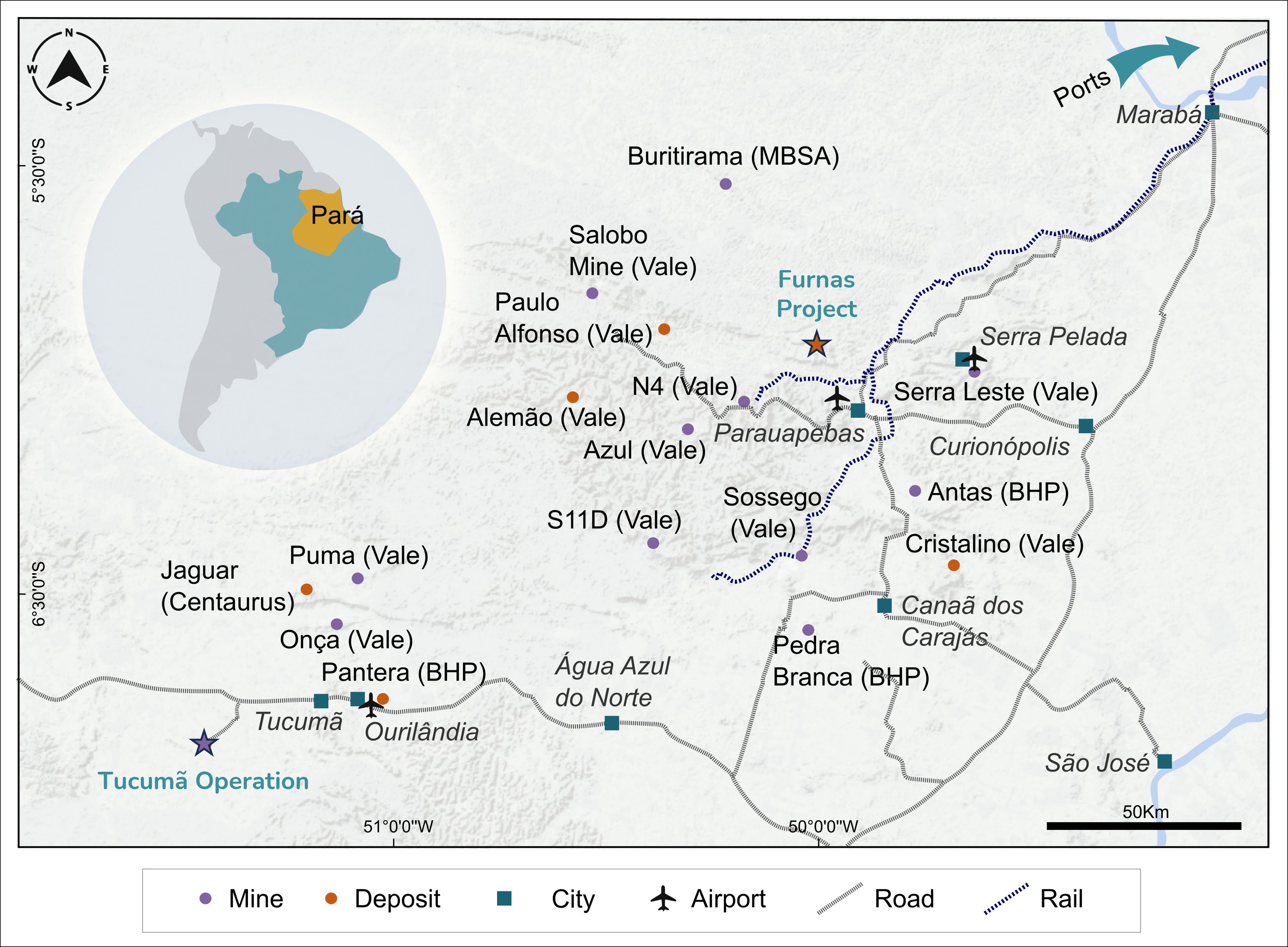
Figure 2: Map of the Carajás Mineral Province, highlighting the location of Furnas in close proximity to extensive regional infrastructure.
Overview of Furnas Earn-In Agreement
In October 2023, the Company entered into a binding term sheet with Salobo Metais S.A., a subsidiary of VBM, providing Ero the right to earn a 60% interest in the Project upon completion of several exploration, engineering and development milestones over a period of five years from the execution of a definitive earn-in agreement, which occurred in July 2024.
Under the terms of the agreement, Ero may earn its 60% interest by completing three staged work programs, including prescribed drilling campaigns and the delivery of a preliminary economic analysis, pre-feasibility study, and definitive feasibility study over a five-year period. During the earn-in period, Ero will solely fund the required exploration and engineering work programs.
Upon completion of the earn-in requirements and a positive investment decision, the parties will form a joint venture, at which point VBM will retain a 40% interest and will receive a free carry of up to 11.0% on future Project construction capital expenditures, subject to defined thresholds.
For additional information regarding the earn-in structure and detailed terms, please refer to the Company’s press releases dated October 30, 2023 and July 22, 2024.
Capital Expenditure Breakdown
| Unit | Initial Capital | Phased Expansion Capital(1) | ||||
| Underground Mines | $M | $179 | $34 | |||
| Open Pit Mines | $M | $132 | $138 | |||
| Processing Plant | $M | $410 | — | |||
| Tailings Management | $M | $48 | — | |||
| Infrastructure | $M | $139 | $22 | |||
| Owners' Team | $M | $8 | — | |||
| Processing Plant indirect Expenditures | $M | $150 | $46 | |||
| Direct & Indirect Capital Expenditures | $M | $1,066 | $239 | |||
| Contingency | $M | $215 | $48 | |||
| Total Capital Expenditures | $M | $1,280 | $287 | |||
(1) Expansion capital related to the Company's phased development strategy occurring after first production. Please refer to the section entitled "A Value-Driven Development and Operating Plan" of this press release for additional information.
Operating Cost Breakdown
| Unit | First 15 Years | Life of Mine | |||||
| Underground Mining | $M | $2,664 | $3,489 | ||||
| Open Pit Mining | $M | $229 | $229 | ||||
| Open Pit Waste Mining | $M | $301 | $301 | ||||
| Processing | $M | $1,535 | $1,857 | ||||
| Tailings Management | $M | $231 | $279 | ||||
| Treatment & Refining | $M | $505 | $602 | ||||
| Concentrate Transportation | $M | $474 | $565 | ||||
| Gold Credit(1) | $M | ($5,091) | ($6,162) | ||||
| Silver Credit(1) | $M | ($287) | ($323) | ||||
| Total Operating Costs | $M | $559 | $837 | ||||
| Copper C1 Cash Cost(2) | $/lb produced | $0.24 | $0.30 | ||||
(1) Assumes long-term metal prices of $3,300/oz Au and $40.00/oz Ag.
(2) C1 Cash Cost is a non-IFRS Measure. Please refer to the Notes section of this press release for a discussion of non-IFRS Measures.
QUALIFIED PERSON AND THE NI 43-101 TECHNICAL REPORT
Mr. Cid Gonçalves Monteiro Filho, SME RM (04317974), MAIG (No. 8444), FAusIMM (No. 329148) has reviewed, verified and approved the scientific and technical information contained in this press release. Mr. Monteiro is Manager, Resources & Reserves of the Company and is a “qualified person” within the meanings of NI 43-101.
The Company will file the associated technical report on SEDAR+ (www.sedarplus.ca/landingpage/) and EDGAR (www.sec.gov), and publish this report on the Company's website (www.ero.com), within 45 days of this press release.
QUALITY ASSURANCE & QUALITY CONTROL
Current QA/QC Program
At the Project, the Company is currently drilling with third-party contracted core drill rigs, operated by Major Drilling Group International Inc. and Drillgeo Geologia e Sondagem Ltda. – independent contractors engaged since October 2024. Drill core is logged, photographed and split in half using a diamond core saw at the Company's core logging and storage facilities. Half of the drill core is retained on site and the other half-core is used for analysis, with samples collected at a minimum of 1.5 meters and a maximum of 2.5 meters with an average length of 2.0 meters. Sampling commences at least 3.0 meters before the start of the mineralized zone and continues at least 3.0 meters beyond the limit of the mineralized zone. Sample collection is performed at the Company's logging facilities with all sample preparation performed at ALS Brasil Ltda.'s laboratory, located in Parauapebas (PA), Brazil, who is independent of the Company. Samples are analyzed by the certified laboratory of ALS Peru S.A., who is independent of the Company. Copper content is determined by four-acid digestion followed by ICP-MS analysis, while gold content is analyzed using fire assay with ICP-AES. When copper grades exceed 1%, Atomic Absorption Spectroscopy is used to determine it. All sample results from the Phase 1 drill program have been monitored through a quality assurance and quality control ("QA/QC") program that includes adherence to the internal operational procedures and the insertion of certified standards, blanks and duplicates at a rate of three standards, one coarse blank, one fine blank, one field duplicate, one coarse duplicate, and one pulp duplicate for every 50 total samples, yielding a blended QC rate of approximately 16%.
QA/QC Validation
The QA/QC validation process undertaken for the Phase 1 drill program of the Project is consistent with the process set out in the NI 43-101 technical report with respect to Furnas, titled “Furnas Copper Project – Para State, Brazil – NI 43-101 Mineral Resource Estimate Technical Report”, dated November 18, 2024 with an effective date of June 30, 2024 (the "2024 Technical Report") and Ero’s internal guidelines and best practices.
For details on the post-mortem QA/QC program performed by the Company on historic drilling completed by Vale S.A. and Anglo American plc, please refer to the Company's press release dated October 2, 2024 and the 2024 Technical Report.
NOTES ON MINERAL RESOURCES
The Canadian Institute of Mining, Metallurgy and Petroleum ("CIM") Definition Standards (2014) were used for reporting the Project's mineral resource estimate, which is effective as at November 30, 2025 and presented on a 100% ownership basis. All figures have been rounded to the relative accuracy of the estimates. Summed amounts may not add due to rounding. Mineral resources that are not mineral reserves do not have a demonstrated economic viability.
Mr. João Estevão Junior, MAIG, of SDPM, an independent qualified person within the meanings of NI 43-101, supervised the preparation and validation of the mineral resource estimate.
Mineral resources have been estimated using a copper price of US$9,039/tonne, a gold price of US$2,500/oz, a silver price of US$24.00/oz, a USD:BRL foreign exchange rate of 5.50, and copper, gold, and silver metallurgical recovery rates of 90.3%, 74.6%, and 71.0%, respectively. The estimation was constrained using Datamine’s MSO for underground and Studio NPVS for open pit optimization. The applied copper-equivalent cut-off grades were 0.45% (break-even) and 0.43% (marginal) for underground, and 0.20% (break-even) and 0.17% (marginal) for open pit. Mineral resources were estimated using ordinary kriging within a 25-meter by 25-meter by 4-meter block size (X, Y, Z), with a minimum sub-block size of 6.25 meters by 6.25 meters by 2.0 meters.
NOTES
Alternative Performance (Non-IFRS) Measures
The Company utilizes certain alternative performance (non-IFRS) measures to monitor its performance, including C1 cash cost of copper produced (per lb), C1 cash cost of gold produced (per ounce), and AISC of gold produced (per ounce). These performance measures have no standardized meaning prescribed within generally accepted accounting principles under IFRS and, therefore, amounts presented may not be comparable to similar measures presented by other mining companies. These non-IFRS measures are intended to provide supplemental information and should not be considered in isolation or as a substitute for measures of performance prepared in accordance with IFRS.
C1 Cash Cost of Copper Produced (per lb)
C1 cash cost of copper produced (per lb) is a non-IFRS performance measure used by the Company to manage and evaluate the operating performance of its copper mining segment and is calculated as C1 cash costs divided by total pounds of copper produced during the period. C1 cash costs comprise the total cost of production, including expenses related to transportation, and treatment and refining charges. These costs are net of by-product credits and incentive payments.
While the C1 cash cost of copper produced per pound is widely reported in the mining industry as a performance benchmark, it does not have a standardized meaning and is disclosed as a supplement to IFRS measures.
ABOUT ERO
Ero is a Brazil-focused, growth-oriented mining company with a diversified portfolio of copper and gold assets. Headquartered in Vancouver, B.C., the Company operates two copper mines – the Caraíba Operations in Bahia State and the Tucumã Operation in Pará State – as well as the Xavantina Operations, a producing gold mine in Mato Grosso State. In addition to its operating assets, Ero is advancing the Furnas Copper-Gold Project, located in the mineral-rich Carajás Province in Pará State, through a definitive earn-in agreement with Vale Base Metals to acquire a 60% interest in the project.
Ero’s operating philosophy is grounded in a commitment to safety, operational excellence, and the responsible production of minerals essential for a better tomorrow. The Company’s shares are publicly traded on the Toronto Stock Exchange and the New York Stock Exchange under the symbol “ERO.” Additional information, including technical reports on the Company’s operations and projects, is available on the Company’s website (www.ero.com), SEDAR+ (www.sedarplus.ca), and on EDGAR (www.sec.gov).
FOR MORE INFORMATION, PLEASE CONTACT
Farooq Hamed, VP, Investor Relations
info@ero.com
CAUTION REGARDING FORWARD LOOKING INFORMATION AND STATEMENTS
This press release contains “forward-looking statements” within the meaning of the United States Private Securities Litigation Reform Act of 1995 and “forward-looking information” within the meaning of applicable Canadian securities legislation (collectively, “forward-looking statements”). Forward-looking statements include statements that use forward-looking terminology such as “may”, “could”, “would”, “will”, “should”, “intend”, “target”, “plan”, “expect”, “budget”, “estimate”, “forecast”, “schedule”, “anticipate”, “contemplate”, “believe”, “continue”, “potential”, “view” or the negative or grammatical variation thereof or other variations thereof or comparable terminology. Forward-looking statements may include, but are not limited to, statements with respect to the Company’s plans, prospects and business strategies and strategic vision and aspirations and their achievement and timing; the results of the Furnas PEA, including but not limited to the mineral resource estimate and the parameters and assumptions used to estimate the mineral resources, future expansion of the mineral resource estimate and the Project, the strategy and objectives of the Company's drill programs, the life of mine, the life of mine plan, mining methods, production estimates and production profile, processing estimates, mining rates, metal grades and production and recovery rates, process flowsheet, costs and expenditures (including capital, sustaining and operating costs, and C1 cash costs) and the timing thereof, economic metrics and sensitivities, estimated economic results (including Project economics, economic metrics, NPV, IRR, and payback period) and the parameters and assumptions used to estimate the economic results, geological and mineralization interpretations, exploration and development activities, timelines and similar statements relating to the economic viability of the Project, tailings management, Project development and construction plans (including staged development, sequencing, timing, the effects and benefits), Project permitting and licensing efforts, community and social engagement; the filing of a technical report in connection with the PEA and the timing thereof; Project studies and their ability to enhance the Project's value (including technical, environmental and social studies); the size and scale of the Furnas Project; the Company’s ability to comply with contractual and permitting or other regulatory and/or earn-in agreement requirements; the results of any Preliminary Economic Assessment, Pre- Feasibility Study, Feasibility Study, or Mineral Resource and Mineral Reserve estimations, and life of mine estimates; anticipated market prices of metals and currency exchange rates; anticipated exploration and development activities at Furnas; the anticipated project development and other plans and expectations with respect to a future 60/40 (Ero/VBM) joint venture; and any other statement that may predict, forecast, indicate or imply future plans, intentions, levels of activity, results, performance or achievements.
Forward-looking statements are subject to a variety of known and unknown risks, uncertainties and other factors that could cause actual results, actions, events, conditions, performance or achievements to materially differ from those expressed or implied by the forward-looking statements, including, without limitation, risks discussed in this press release and in the Company’s most recent Annual Information Form (“AIF”) under the heading “Risk Factors”. The risks discussed in this press release and in the AIF are not exhaustive of the factors that may affect any of the Company’s forward-looking statements. Although the Company has attempted to identify important factors that could cause actual results, actions, events, conditions, performance or achievements to differ materially from those contained in forward-looking statements, there may be other factors that cause results, actions, events, conditions, performance or achievements to differ from those anticipated, estimated or intended.
Forward-looking statements are not a guarantee of future performance. There can be no assurance that forward-looking statements will prove to be accurate, as actual results and future events could differ materially from those anticipated in such statements. Forward-looking statements involve statements about the future and are inherently uncertain, and the Company’s actual results, achievements or other future events or conditions may differ materially from those reflected in the forward-looking statements due to a variety of risks, uncertainties and other factors, including, without limitation, those referred to herein and in the AIF under the heading “Risk Factors”.
The Company’s forward-looking statements are based on the assumptions, beliefs, expectations and opinions of management on the date the statements are made, many of which may be difficult to predict and beyond the Company’s control. In connection with the forward-looking statements contained in this press release and in the AIF, the Company has made certain assumptions about, among other things: favourable equity and debt capital markets; the ability to raise any necessary additional capital on reasonable terms to advance the production, development and exploration of the Company’s properties and assets; future prices of copper, gold and other metal prices; the timing and results of exploration and drilling programs; the accuracy of any mineral reserve and mineral resource estimates; the geology of the Caraíba Operations, the Xavantina Operations, the Tucumã Operation and the Furnas Copper-Gold Project being as described in the respective technical report for each property; production costs; the accuracy of budgeted exploration, development and construction costs and expenditures; the price of other commodities such as fuel; future currency exchange rates, interest rates and tariff rates; operating conditions being favourable such that the Company is able to operate in a safe, efficient and effective manner; work force continuing to remain healthy in the face of prevailing epidemics, pandemics or other health risks, political and regulatory stability; the receipt of governmental, regulatory and third party approvals, licenses and permits on favourable terms; obtaining required renewals for existing approvals, licenses and permits on favourable terms; requirements under applicable laws; sustained labour stability; stability in financial and capital goods markets; availability of equipment; positive relations with local groups and the Company’s ability to meet its obligations under its agreements with such groups; and satisfying the terms and conditions of the Company’s current loan arrangements. Although the Company believes that the assumptions inherent in forward-looking statements are reasonable as of the date of this press release, these assumptions are subject to significant business, social, economic, political, regulatory, competitive and other risks and uncertainties, contingencies and other factors that could cause actual actions, events, conditions, results, performance or achievements to be materially different from those projected in the forward-looking statements. The Company cautions that the foregoing list of assumptions is not exhaustive. Other events or circumstances could cause actual results to differ materially from those estimated or projected and expressed in, or implied by, the forward-looking statements contained in this press release. There can be no assurance that forward-looking statements will prove to be accurate, as actual results and future events could differ materially from those anticipated in such statements. Accordingly, readers should not place undue reliance on forward-looking statements.
Forward-looking statements contained herein are made as of the date of this press release and the Company disclaims any obligation to update or revise any forward-looking statement, whether as a result of new information, future events or results or otherwise, except as and to the extent required by applicable securities laws.
CAUTIONARY NOTES REGARDING MINERAL RESOURCE AND MINERAL RESERVE ESTIMATES
Unless otherwise indicated, all reserve and resource estimates included in this press release and the documents incorporated by reference herein have been prepared in accordance with National Instrument 43-101, Standards of Disclosure for Mineral Projects (“NI 43-101") and the Canadian Institute of Mining, Metallurgy and Petroleum (the “CIM”) — CIM Definition Standards on Mineral Resources and Mineral Reserves, adopted by the CIM Council, as amended (the “CIM Standards”). NI 43-101 is a rule developed by the Canadian Securities Administrators that establishes standards for all public disclosure an issuer makes of scientific and technical information concerning mineral projects. Canadian standards, including NI 43-101, differ significantly from the requirements of the United States Securities and Exchange Commission (the “SEC”), and reserve and resource information included herein may not be comparable to similar information disclosed by U.S. companies. In particular, and without limiting the generality of the foregoing, this press release and the documents incorporated by reference herein use the terms “measured resources,” “indicated resources” and “inferred resources” as defined in accordance with NI 43-101 and the CIM Standards.
Further to recent amendments, mineral property disclosure requirements in the United States (the “U.S. Rules”) are governed by subpart 1300 of Regulation S-K of the U.S. Securities Act of 1933, as amended (the “U.S. Securities Act”) which differ from the CIM Standards. As a foreign private issuer that is eligible to file reports with the SEC pursuant to the multi-jurisdictional disclosure system (the “MJDS”), Ero is not required to provide disclosure on its mineral properties under the U.S. Rules and will continue to provide disclosure under NI 43-101 and the CIM Standards. If Ero ceases to be a foreign private issuer or loses its eligibility to file its annual report on Form 40-F pursuant to the MJDS, then Ero will be subject to the U.S. Rules, which differ from the requirements of NI 43-101 and the CIM Standards.
Pursuant to the new U.S. Rules, the SEC recognizes estimates of “measured mineral resources”, “indicated mineral resources” and “inferred mineral resources.” In addition, the definitions of “proven mineral reserves” and “probable mineral reserves” under the U.S. Rules are now “substantially similar” to the corresponding standards under NI 43-101. Mineralization described using these terms has a greater amount of uncertainty as to its existence and feasibility than mineralization that has been characterized as reserves. Accordingly, U.S. investors are cautioned not to assume that any measured mineral resources, indicated mineral resources, or inferred mineral resources that Ero reports are or will be economically or legally mineable. Further, “inferred mineral resources” have a greater amount of uncertainty as to their existence and as to whether they can be mined legally or economically. Under Canadian securities laws, estimates of “inferred mineral resources” may not form the basis of feasibility or pre-feasibility studies, except in rare cases. While the above terms under the U.S. Rules are “substantially similar” to the standards under NI 43-101 and CIM Standards, there are differences in the definitions under the U.S. Rules and CIM Standards. Accordingly, there is no assurance any mineral reserves or mineral resources that Ero may report as “proven mineral reserves”, “probable mineral reserves”, “measured mineral resources”, “indicated mineral resources” and “inferred mineral resources” under NI 43-101 would be the same had Ero prepared the reserve or resource estimates under the standards adopted under the U.S. Rules.
Photos accompanying this announcement are available at
https://www.globenewswire.com/NewsRoom/AttachmentNg/2af9e1d6-b439-4c25-bcab-524c43a77d7b
https://www.globenewswire.com/NewsRoom/AttachmentNg/9d923958-3ee8-4c79-8bbb-645b437bde72
https://www.globenewswire.com/NewsRoom/AttachmentNg/d1419223-da67-47ee-b834-50c87c963256
https://www.globenewswire.com/NewsRoom/AttachmentNg/c76bc8a9-cb5a-43b0-9449-1ebf33a3cd71
https://www.globenewswire.com/NewsRoom/AttachmentNg/26b80a98-07dc-4854-9e54-da3506cd6aac


