Carpinteria, CA, March 30, 2026 (GLOBE NEWSWIRE) -- This announcement is based on publicly available materials from ProHealth Longevity regarding its BPC-157 formulation, including how the product is described within current market discussions and category-level positioning language. The phrase "most effective" reflects positioning language used in competitive marketing contexts and does not represent a clinically established comparative conclusion.
This article contains affiliate links. If a purchase is made through these links, a commission may be earned at no additional cost to the buyer. This article is an informational overview and does not constitute medical, health, or dietary advice. All product details described below are stated as presented by the company and should be verified directly on the official website before any purchasing decision.
These statements have not been evaluated by the Food and Drug Administration. This product is not intended to diagnose, treat, cure, or prevent any disease. Always consult a qualified healthcare professional before starting any new supplement.
If you've been looking into BPC-157 peptide supplements heading into 2026, you've probably noticed that finding reliable information is harder than it should be. The peptide market has exploded with options — and with that growth has come a wide range of quality, transparency, and marketing claims that can make it genuinely difficult to figure out what you're actually getting.
ProHealth Longevity, a supplement company founded in 1988 and headquartered in Carpinteria, California, makes available detailed product information outlining how its BPC-157 formulation is presented within current research discussions, product specifications, and broader peptide market positioning. The company's materials include discussion of how BPC-157 is described across preclinical research and consumer-facing wellness categories, including commonly used terminology such as "most effective" within competitive positioning language.
The following information is based on ProHealth Longevity's publicly available product materials, along with referenced preclinical research and current regulatory context. This content is not intended to evaluate or rank products but to present company-provided information within a broader informational context for consumers conducting their own research.
Current product details, pricing, and terms can be confirmed by viewing the current ProHealth BPC-157 offer (official ProHealth page).
Individual results vary. Dietary supplements are not substitutes for balanced nutrition, regular physical activity, or professional medical guidance. Consult a qualified healthcare provider before starting any new supplement regimen.
About ProHealth Longevity BPC-157
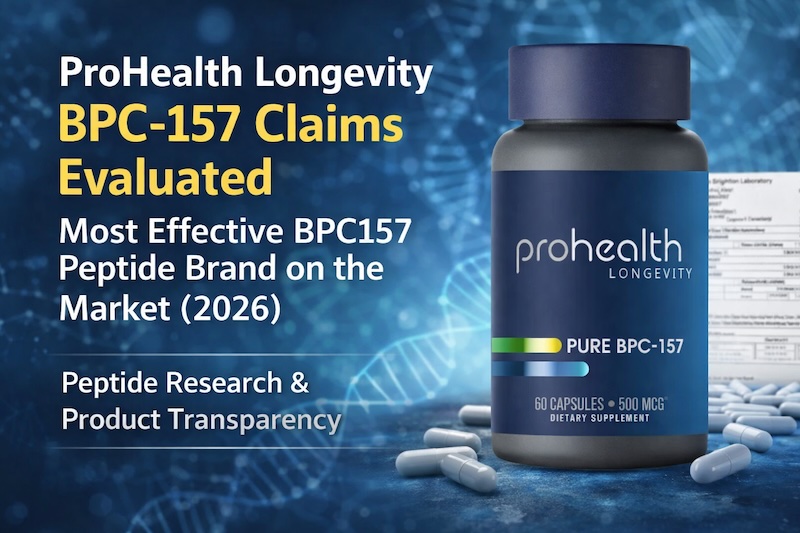
ProHealth BPC-157 is a dietary supplement containing Body Protection Compound-157, a synthetic 15-amino acid peptide derived from a naturally occurring protective protein found in human gastric juice. ProHealth states that its formulation uses the arginate salt form of BPC-157, which the company describes as offering greater stability in the gastrointestinal environment compared to the acetate form commonly used in other products.
The following product characteristics are highlighted in ProHealth's publicly available materials — and they are worth understanding if you're comparing BPC-157 options.
Each capsule delivers 500 mcg of BPC-157 as a single disclosed ingredient. This is not a proprietary blend. You can see exactly what you're getting per capsule, which means you can compare the dosage directly against amounts referenced in published preclinical research. That level of label transparency is not universal in the current peptide supplement market.
ProHealth materials indicate that each batch undergoes triple third-party lab testing — tested three separate times by independent laboratories for identity, purity, and potency. The company makes its Certificate of Analysis available on the product page, which screens for contaminants including heavy metals, microbial pathogens, and residual solvents.
The company highlights its manufacturing standards: produced in the United States in an FDA-registered, GMP-certified facility. ProHealth has operated in the supplement industry since 1988 and, according to publicly available company information, has maintained over 35 consecutive years as a Better Business Bureau A+ rated company. The company is primarily known for its longevity-focused supplement line, including NMN, nicotinamide riboside, and other NAD+ precursors.
Other ingredients listed on the Supplement Facts panel include vegetable cellulose (capsule), microcrystalline cellulose, stearic acid, and silica.
Research Context Referenced by ProHealth
BPC-157 has generated significant scientific interest, and ProHealth references a growing body of preclinical research in its product materials. Understanding what that research shows — and equally important, what it does not yet show — is one of the most useful things you can do before evaluating any BPC-157 product.
Preclinical research means studies conducted in animal models and laboratory settings. These are real studies published in real peer-reviewed journals. They are not, however, the same as controlled clinical trials in human subjects.
A 2019 review published in Cell Tissue Research (Gwyer D et al.) examined preclinical evidence for BPC-157's effects on musculoskeletal tissue, noting the peptide's potential to support muscle, tendon, and ligament repair pathways in animal models. A 2018 paper in Current Pharmaceutical Design (Seiwerth S et al.) reviewed BPC-157's observed effects on angiogenesis — the formation of new blood vessels — and its potential role in tissue healing processes.
A 2024 review published in the Yale Journal of Biology and Medicine (Cushman CJ et al.) provided an updated synthesis examining BPC-157's potential applications across gut, musculoskeletal, and neurological systems. And a 2025 systematic review specifically examined BPC-157 from an orthopedic sports medicine perspective, noting the peptide's potential for promoting healing in musculoskeletal injuries — including fractures, tendon ruptures, and muscle injuries — in preclinical models.
These are meaningful findings on a compound that has attracted genuine scientific attention. But there are important distinctions worth sitting with before connecting published research to any specific supplement sitting in your cart.
The human clinical trial gap: As of this writing, no published randomized, placebo-controlled human clinical trial has evaluated BPC-157 for any indication. The 2025 systematic review noted that despite increasing clinical use, this level of evidence does not yet exist. Much of the foundational research also comes from a single research group, which limits the breadth of independent validation.
Delivery method differences: Most published BPC-157 research has used injectable administration in animal subjects. ProHealth's product is an oral capsule. Some preclinical data suggests BPC-157 demonstrates oral bioavailability, but direct comparisons between injectable study protocols and oral supplementation in humans have not been established through clinical research.
ProHealth references these studies to provide context for how BPC-157 is discussed within scientific literature. The company's product page includes numbered citations to published peer-reviewed papers. This is ingredient-level research context — ProHealth BPC-157 as a finished supplement has not been the subject of an independent clinical study.
None of this means the product lacks utility. It means understanding exactly where the evidence stands helps you make a purchasing decision based on what has actually been demonstrated rather than what marketing language might imply.
Market Positioning and Category Language
The term "most effective peptide" appears within competitive market positioning language referenced in ProHealth's materials. Evaluating what that language means in practice requires understanding what would be needed to substantiate it — and what ProHealth can point to as quality differentiators.
For any supplement brand to clinically demonstrate that its BPC-157 product is "most effective," the standard would generally require independent, head-to-head comparative studies against competing products, measuring defined endpoints in human subjects. No such comparative study exists for any commercially available BPC-157 supplement as of this writing — including ProHealth's formulation.
What ProHealth can point to as differentiators — and these are the kinds of quality signals worth weighing when you're comparing options:
Transparent, single-ingredient dosing. The 500 mcg per capsule is fully disclosed, not hidden in a proprietary blend. In a market where many peptide products use blends that obscure individual ingredient amounts, this matters.
Third-party testing documentation. ProHealth states that its Certificate of Analysis is available on the product page. Triple independent lab testing with available documentation represents a level of transparency that may not be consistently found across all products in this category.
Arginate salt formulation. The company highlights its use of the arginate salt form, which it describes as offering greater gastrointestinal stability for oral delivery compared to acetate-form products.
36-year company track record. ProHealth has operated since 1988 with a maintained BBB A+ rating. For a product category where new brands appear and disappear regularly, company longevity is a relevant trust signal.
These are meaningful quality indicators. Whether they collectively support the competitive positioning language of "most effective" is something each consumer will need to weigh alongside their own research, their healthcare provider's guidance, and their individual priorities.
Regulatory Considerations
BPC-157 occupies one of the more complex regulatory positions in the current supplement landscape, and understanding this context is genuinely important before purchasing any BPC-157 product — regardless of brand.
FDA Category 2 Classification: In September 2023, the FDA added BPC-157 to its Category 2 bulk drug substance list. This means the agency determined it cannot be used by licensed compounding pharmacies for compounded medications under sections 503A and 503B of the Federal Food, Drug, and Cosmetic Act. The FDA cited insufficient evidence on safety for human use in the compounding context.
Pending Reclassification Developments (February 2026): In February 2026, HHS Secretary Robert F. Kennedy Jr. announced that approximately 14 of 19 previously restricted peptides — reportedly including BPC-157 — are expected to be moved back to Category 1 status, which would restore legal compounding pharmacy access. However, as of the publication date of this article, no formal FDA reclassification has been finalized. Public statements and announcements do not constitute completed regulatory action until formally published by the FDA.
Supplement vs. Compounded Drug Distinction: ProHealth sells BPC-157 as a dietary supplement regulated under DSHEA — not as a compounded prescription medication. The FDA's Category 2 restriction specifically governs compounding pharmacies. Many BPC-157 products continue to be sold as dietary supplements through a separate regulatory pathway.
No FDA-Approved Indication: BPC-157 has no FDA-approved indication for any medical condition. No pharmaceutical company has initiated FDA clinical trials for BPC-157.
WADA Prohibition: BPC-157 is prohibited by the World Anti-Doping Agency (WADA) under Section S0: Non-Approved Substances. Competitive athletes governed by WADA, NCAA, NFL, NBA, MLB, NHL, UFC, or other sanctioning bodies should be aware that BPC-157 use is banned in and out of competition.
The regulatory environment for BPC-157 is in active transition. Reviewing the most current FDA guidance and discussing any BPC-157 supplement with a qualified healthcare provider before purchasing is the most responsible approach.
Product Specifications and Transparency
According to product information available on the official ProHealth website at the time of this writing:
Product: Pure BPC-157 — 500 mcg, 60 Capsules (SKU: PH703)
Price: ProHealth materials indicate the product is listed at $119.95. The company also offers a Subscribe and Save option, which the website states can provide savings of up to 30 percent on recurring orders.
Active Ingredient: Body Protection Compound-157 (as BPC-157 Arginate Salt), 500 mcg per capsule
Other Ingredients: Vegetable cellulose (capsule), microcrystalline cellulose, stearic acid, silica
Suggested Use: According to the label, take one capsule daily, with or without food, or as directed by a healthcare professional. The company's product materials recommend consistent use for 4 to 8 weeks.
Guarantee: ProHealth materials indicate a 100-day, 100 percent satisfaction guarantee. The company's return policy states that customers can return the unused portion for a full refund of the product cost. According to the stated terms, shipping charges are nonrefundable.
Shipping: ProHealth states that free U.S. shipping is available on orders over $30. According to the company, orders placed by 11:00 AM Pacific Time on business days ship the same day.
Pricing and availability can change. Verify current terms by viewing the current ProHealth BPC-157 offer (official ProHealth page).
Consumer Considerations
Based on ProHealth's product positioning and the current state of BPC-157 research, here are the considerations that matter most depending on where you're coming from.
ProHealth BPC-157 may be considered by individuals who:
Prioritize third-party testing transparency. ProHealth makes its Certificate of Analysis available on the product page and states that each batch is tested three times by independent labs. In a peptide market where product purity varies widely and many brands provide no testing documentation at all, this is a meaningful differentiator worth weighing.
Prefer oral capsule delivery over injections. Many BPC-157 products on the market require subcutaneous injection. ProHealth's capsule format offers a needle-free alternative. Keep in mind that most preclinical research has used injectable delivery, so the oral bioavailability question is relevant context for your evaluation.
Value an established company track record. ProHealth has operated in the supplement space since 1988. If company history, manufacturing standards, and industry reputation factor into your decision-making alongside product-specific claims, that longevity is relevant.
Are exploring peptide supplementation under healthcare provider guidance. Adults interested in the emerging preclinical research around BPC-157 for recovery support, gut comfort, or joint health — and who plan to discuss supplementation with their provider — may find ProHealth's formulation worth that conversation.
Other options may be preferable for people who:
Require human clinical trial evidence on the finished product. No published randomized, controlled human clinical trial has evaluated ProHealth BPC-157 — or any commercially available BPC-157 supplement — as a finished formulation. If product-level clinical proof is your threshold, that evidence does not yet exist for this category.
Are competitive athletes subject to drug testing. BPC-157 is prohibited by WADA and banned by most major professional and collegiate sports organizations. Athletes should not use this product.
Questions worth asking yourself:
Have you discussed BPC-157 supplementation with your healthcare provider, particularly regarding any current medications or health conditions? Do you understand the difference between preclinical animal research and human clinical trial evidence? Are you comfortable with the current regulatory status of BPC-157 products? Does the product you're considering provide verifiable third-party testing documentation? Is the dosage clearly disclosed rather than hidden in a proprietary blend?
Your answers to those questions help determine which product characteristics matter most for your specific situation.
Frequently Asked Questions
Is ProHealth BPC-157 FDA approved?
ProHealth BPC-157 is a dietary supplement. Under current federal regulations, dietary supplements do not require FDA approval before being sold. The FDA does not evaluate supplement efficacy claims. ProHealth states the product is manufactured in an FDA-registered, GMP-certified facility, which relates to manufacturing standards rather than product approval.
What is the difference between the arginate and acetate forms of BPC-157?
ProHealth materials indicate that the arginate salt form is considered to have greater stability in the gastrointestinal environment compared to the acetate form. The company states it chose arginate to help ensure consistency, potency, and performance when taken orally. Both forms contain the same BPC-157 peptide sequence.
How does an oral BPC-157 capsule differ from injectable BPC-157?
ProHealth BPC-157 is an oral capsule. Most preclinical BPC-157 research has used injectable delivery methods in animal subjects. Some preclinical data suggests BPC-157 demonstrates oral bioavailability, but direct comparisons between oral and injectable delivery in humans have not been established through published clinical trials.
Is BPC-157 legal to purchase as a supplement?
BPC-157 dietary supplements are currently sold commercially in the United States. The FDA's 2023 Category 2 classification specifically restricts compounding pharmacies, while dietary supplements are regulated under DSHEA through a different pathway. The regulatory landscape continues to evolve — verify current status before purchasing.
Can competitive athletes use BPC-157?
BPC-157 is prohibited by the World Anti-Doping Agency under Section S0: Non-Approved Substances. It is also restricted by the NCAA, NFL, NBA, MLB, NHL, UFC, and most other professional and collegiate sports organizations. Competitive athletes should not use this product.
How long does ProHealth suggest using BPC-157 before evaluating results?
The company's product materials suggest consistent daily use for 4 to 8 weeks. ProHealth's FAQ notes that some individuals report noticeable improvements within a few weeks, while for others benefits may take longer. Individual responses vary based on numerous personal health factors.
What is ProHealth's return policy for BPC-157?
ProHealth materials indicate a 100-day satisfaction guarantee. The company's return policy states customers can return the unused portion for a full refund of the product cost. Shipping charges are nonrefundable according to the stated terms. Verify current guarantee terms on the official website before ordering.
What testing does ProHealth perform on its BPC-157?
ProHealth states that each batch undergoes third-party testing three times by independent labs for identity, purity, and potency. Testing screens for contaminants including heavy metals, microbial pathogens, and residual solvents. The company makes its Certificate of Analysis available on the product page.
Additional Consumer Information
Consumers researching BPC-157 oral supplements may benefit from reviewing previously available independent consumer reporting on this product category. A 2026 consumer guide covering the best BPC-157 oral supplements, ingredient transparency, and purchasing considerations provides additional context on what to look for when comparing peptide supplement options.
Evaluating multiple sources of information is recommended before making any purchasing decision. Consumers may also wish to review the FDA's general guidance on dietary supplement labeling and claims, as well as current regulatory developments related to peptide compounds.
Summary
ProHealth Longevity's BPC-157 supplement is presented as a premium option in the growing oral peptide market, featuring a single transparent ingredient at a disclosed 500 mcg dosage using the arginate salt form, triple third-party lab testing with available Certificates of Analysis, and the backing of a company with over 36 years in the supplement industry.
The preclinical research on BPC-157 as a compound is extensive and growing, with studies in peer-reviewed journals examining its potential for tissue repair support, gut health, musculoskeletal recovery, and inflammatory response modulation in animal models. That research has not yet progressed to randomized, controlled human clinical trials for any indication — a distinction that applies across the entire BPC-157 product category, not just to ProHealth's formulation.
The competitive positioning language of "most effective" reflects how the product is described within market discussions. No independent comparative study exists to establish this as a clinically validated conclusion. What ProHealth does offer — transparent dosing, available COAs, arginate salt formulation, oral capsule convenience, and a long-standing industry track record — represents quality indicators that consumers can evaluate alongside their own research and healthcare provider guidance.
The regulatory environment for BPC-157 is in active transition heading into 2026. Consumers should review the most current FDA guidance and discuss BPC-157 supplementation with a qualified healthcare provider before making a purchasing decision.
This announcement is intended to present company-provided information within a broader informational context and does not constitute a product review, endorsement, or comparative ranking.
Complete product details, current pricing, and terms are available by viewing the current ProHealth BPC-157 offer (official ProHealth page).
Contact Information
According to ProHealth, the company offers customer support through the following channels:
Company: ProHealth, Inc.
Toll Free: (800) 366-6056
US Direct: (805) 564-3064
International: 001.805.564.3064
Fax: (805) 684-6199 or 001.805.684-6199
Email: CustomerLoyalty@prohealth.com
Customer Service Hours: Monday through Friday, 8 AM to 5 PM Pacific Time
Product Return Address: ProHealth, Inc., 555 Maple St, Carpinteria, CA 93013, USA
View the current ProHealth BPC-157 offer (official ProHealth page)
Disclaimers
FDA Health Disclaimer: These statements have not been evaluated by the Food and Drug Administration. This product is not intended to diagnose, treat, cure, or prevent any disease. Always consult your physician before starting any new supplement, especially if you have existing health conditions, take medications, or are pregnant or nursing.
Professional Medical Disclaimer: This article is educational and does not constitute medical advice. ProHealth BPC-157 is a dietary supplement, not a medication. If you are currently taking medications, have existing health conditions, are pregnant or nursing, or are considering any major changes to your health regimen, consult your physician before starting this or any new supplement. Do not change, adjust, or discontinue any medications or prescribed treatments without your physician's guidance and approval.
Preclinical Research Notice: The scientific references cited in this article and on the ProHealth product page describe preclinical research conducted primarily in animal models and laboratory settings. These findings do not constitute proof of efficacy in humans. No published randomized, controlled clinical trial has evaluated BPC-157 — including ProHealth's specific formulation — for any human health indication. Individual ingredient research does not mean the finished product will produce comparable results in human supplementation.
Regulatory Status Notice: BPC-157 has no FDA-approved indication for any medical condition. In 2023, the FDA classified BPC-157 as a Category 2 bulk drug substance, restricting its use by compounding pharmacies. As of the publication date of this article, announcements regarding potential reclassification have been made but no formal FDA regulatory action has been finalized. The regulatory environment for BPC-157 is subject to change. Consumers should verify current regulatory status before purchasing. BPC-157 is prohibited by the World Anti-Doping Agency and most professional and collegiate sports organizations.
Results May Vary: Individual results will vary based on factors including age, baseline health condition, lifestyle factors, consistency of use, genetic factors, current medications, and other individual variables. While some customers report improvements, results are not guaranteed.
FTC Affiliate Disclosure: This article contains affiliate links. If a purchase is made through these links, a commission may be earned at no additional cost to the buyer. This compensation does not influence the accuracy, neutrality, or integrity of the information presented. All descriptions are based on published research and publicly available information.
Pricing Disclaimer: All prices, discounts, and promotional offers mentioned were accurate at the time of publication (March 2026) but are subject to change without notice. Always verify current pricing and terms on the official ProHealth website before making a purchase.
Publisher Responsibility Disclaimer: The publisher of this article has made every effort to ensure accuracy at the time of publication. We do not accept responsibility for errors, omissions, or outcomes resulting from the use of the information provided. Readers are encouraged to verify all details directly with ProHealth and their healthcare provider before making decisions.

Toll Free: (800) 366-6056 US Direct: (805) 564-3064 International: 001.805.564.3064 Fax: (805) 684-6199 or 001.805.684-6199 Email: CustomerLoyalty@prohealth.com Customer Service Hours: Monday through Friday, 8 AM to 5 PM Pacific Time